Give Muse control of your browser
Turn on Remote in the Vibe extension, send Muse one prompt, paste your session ID on the secure card — and Muse can use your real Chrome.
One prompt builds it
You send Muse one prompt and paste the session ID once, on the secure card — Muse builds the connector for you.
Lives in your connectors
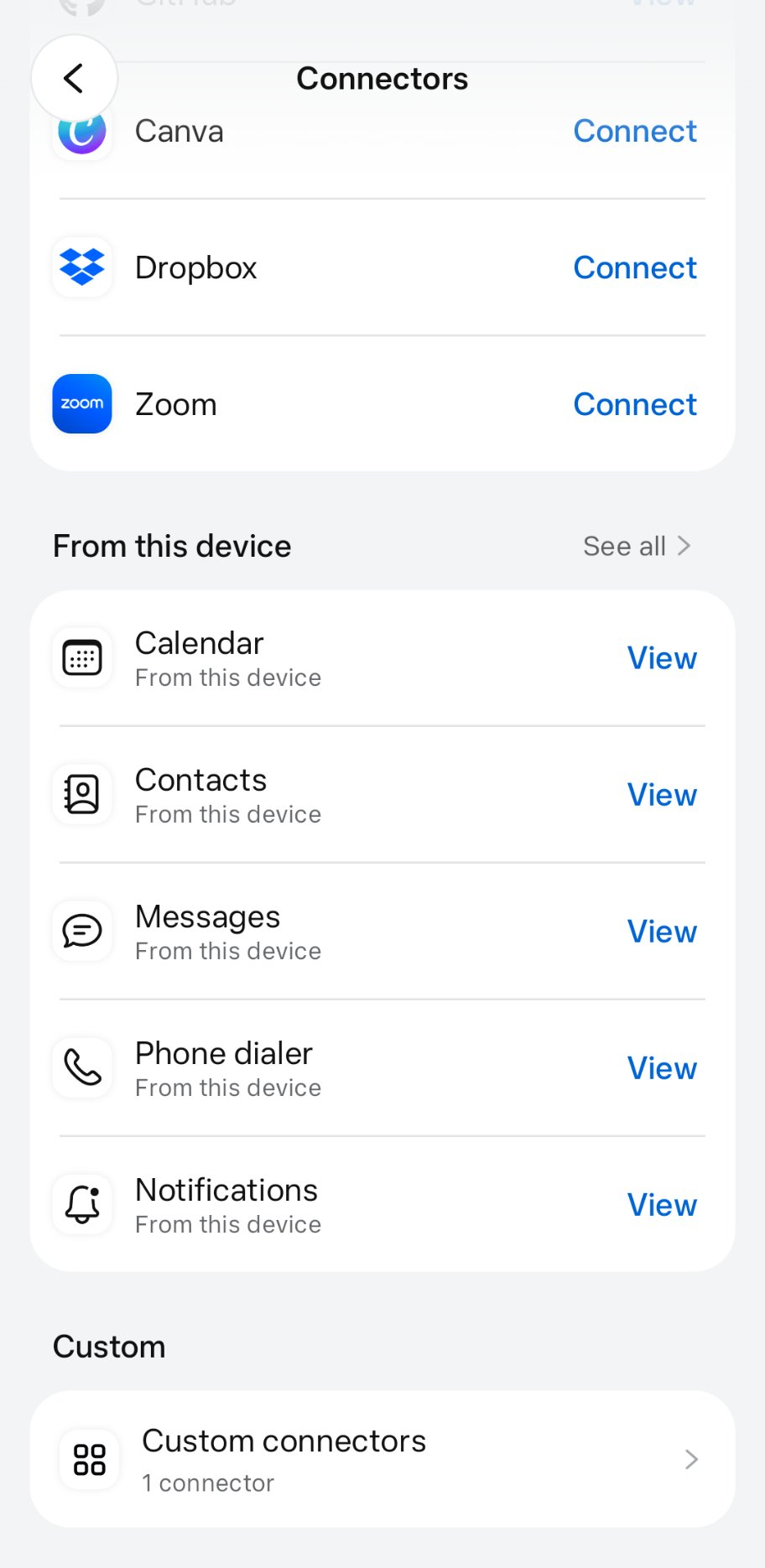
The connector appears in Settings → Connectors → Custom connectors, where you can view and manage it.
Works inside your Chrome
After that, Muse works inside the Chrome you are already logged into.
How it works
What the secure card actually connects to
You connect Vibe Browser to Muse from chat: send Muse the prompt on this page — it contains no secret — then paste your session ID, the part at the end of the MCP connector URL in the extension, on the secure card Muse shows you. Muse adds Vibe Browser as a custom connector. It then lives in the Muse app under Settings → Connectors → Custom connectors, and Muse can open, read, and act on pages in your real Chrome.
  Muse app (chat)
        │
        │  send the prompt → Muse opens a secure card
        ▼
  Add custom connector card   ← paste ONLY the session ID
        │
        ▼
  https://relay.api.vibebrowser.app/mcp/<session-id>   ← routes by session ID
        │
        ▼
Vibe extension in your real Chrome ← set to "Remote (internet)"In the Relay access box, find "MCP connector URL (HTTPS)". Your session ID is the part at the end of that URL, after /mcp/. Keep this settings page open — in step 5 you paste that ID once, on Muse’s secure card. Never paste it into a chat.
MCP connector URL (HTTPS)
https://relay.api.vibebrowser.app/mcp/<your-session-id>The card takes only the last segment, after /mcp/ — never the full URL.
The /mcp/<your-routing-uuid> URL above is a bearer capability for your real, logged-in browser. There is no second factor: anyone who holds it can open your tabs, read the pages you are signed into, and act as you. Nothing else is needed to use it.
- Never paste it into a shared chat, a ticket, a README, a screenshot, or a support thread. Redact the UUID before sharing anything.
- Never commit it to a repo or write it into a config file that gets committed. Keep it out of shell history and CI logs.
- If it leaks — or you are unsure — open the Vibe extension settings and regenerate the connection URL. The old UUID stops routing immediately, and you re-paste the new URL into the connector.
- Turn "Enable external AI agent control" off when you are not using it. With it off, the URL routes nowhere.
Quickstart
Connect Muse in 6 steps
Install the extension, turn on remote control, copy the session ID, send Muse one prompt, then paste the ID on its secure card.
Install the Vibe Browser extension
Add Vibe Browser to Chrome from the Chrome Web Store — the "Add Vibe to Chrome" button on this page opens the listing. Then click the Vibe icon in the Chrome toolbar once so the extension is active.
Open AI Agent Control in the extension settings
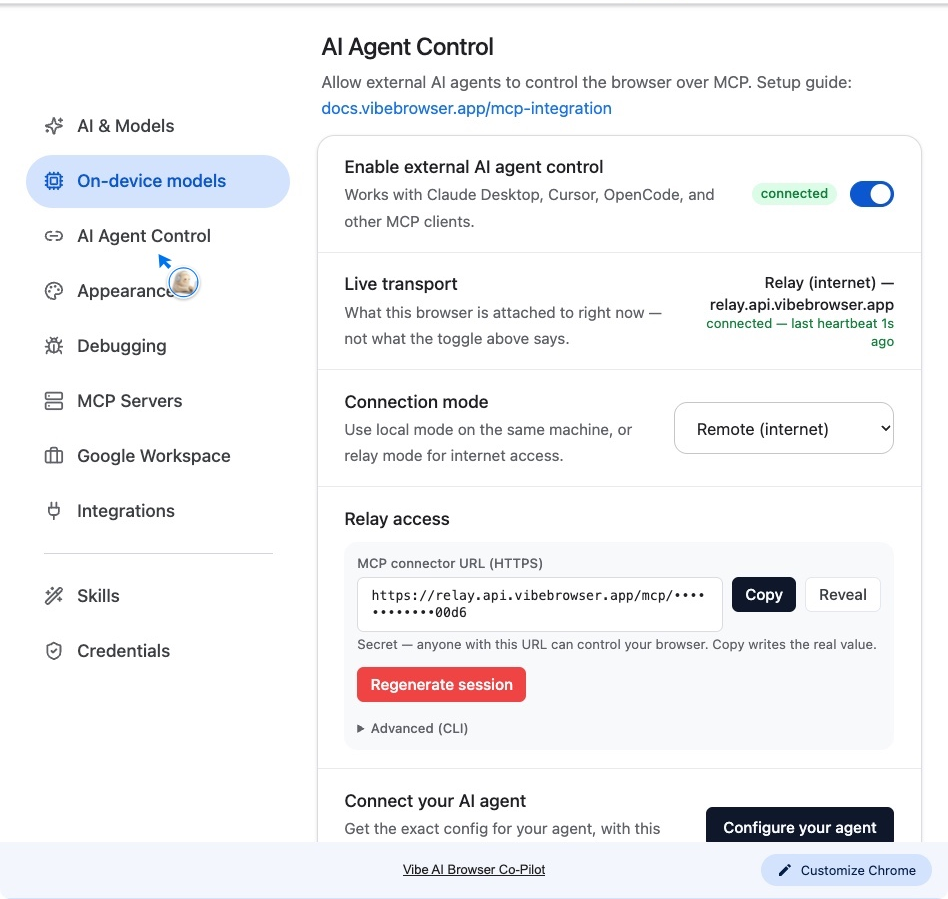
Click the Vibe icon → Settings → AI Agent Control. Turn on "Enable external AI agent control" and set Connection mode to Remote (internet).
Find your session ID in the extension
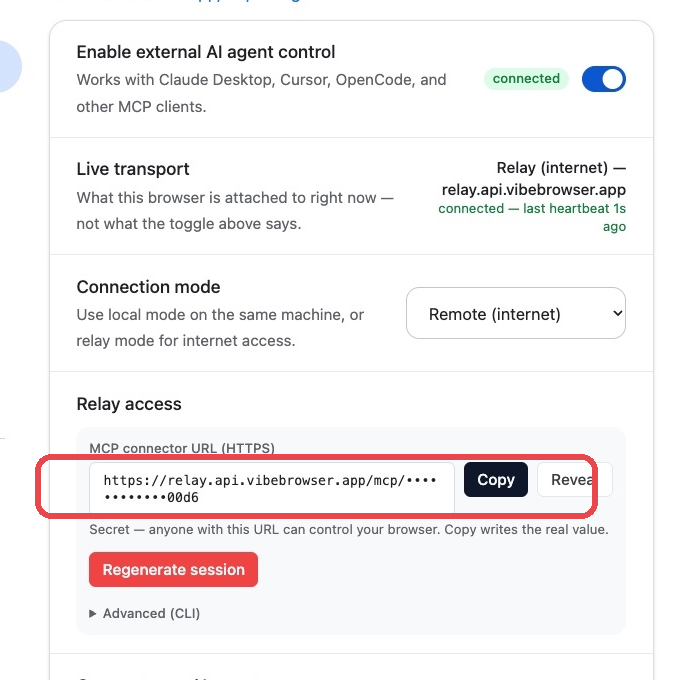
In the Relay access box, find "MCP connector URL (HTTPS)". Your session ID is the part at the end of that URL, after /mcp/. Keep this settings page open — in step 5 you paste that ID once, on Muse’s secure card. Never paste it into a chat.
Send Muse this prompt
Open Muse and send the prompt below. It contains no secret. Muse replies with a secure credential card for the key — that card is the next step. Once the connector is added, Muse checks it by listing your tabs.
Paste into a Muse chat
Add a custom connector named "Vibe Browser" for the Vibe Browser MCP server. The server host is relay.api.vibebrowser.app, and my session ID is sent in the X-Remote-Session header — ask me for the session ID on the secure credential card, and I will paste it there. Once it is connected, list my open browser tabs to check it works, and do not click or change anything yet.Paste the session ID on the card
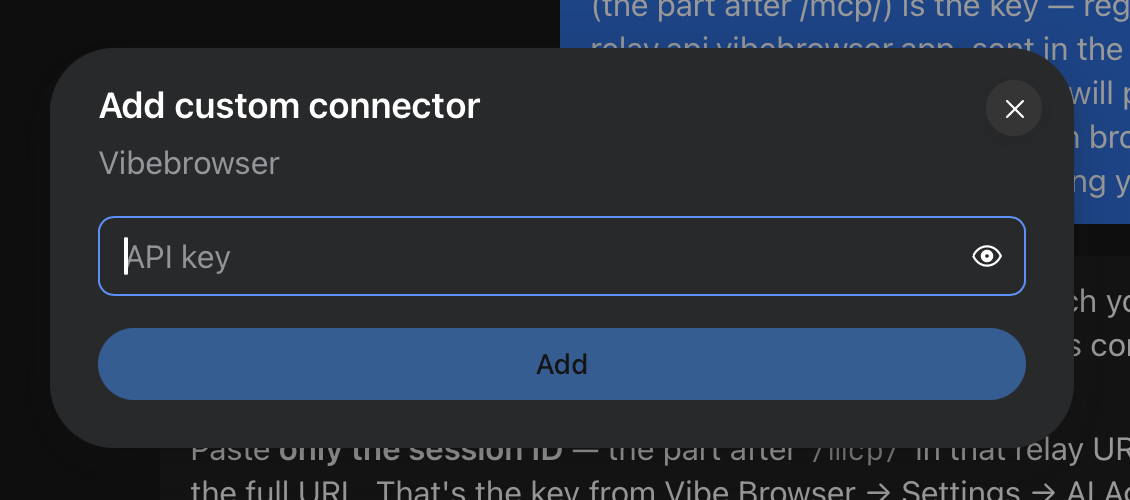
Muse shows an "Add custom connector" card for Vibebrowser with a single API key field. Paste only the session ID from step 3 — not the full URL — and tap Add. The name and host are already set from the prompt; the relay takes the bare ID in that field.
Find it in your connectors
When Muse confirms the connection and lists your tabs, open Settings → Connectors in the Muse app and scroll to Custom → Custom connectors. Vibe Browser is listed there — that is where you view and manage it.
The steps follow the Muse app as it works today: one prompt in chat, the session ID pasted on the secure Add custom connector card, then the connector listed under Settings → Connectors → Custom connectors. The screenshots on this page are from the real app and the real extension settings. A full end-to-end run with a live Muse account is still being verified, so treat this page as a guide.
Where does the connector live in Muse?
In the Muse app: Settings → Connectors → Custom connectors. There is no add form in Settings — the prompt in step 4 creates the connector, and it appears in that list, where you can view and manage it.
Is the MCP connector URL a secret?
Yes — the session ID is a key to your browser, so it only ever goes on Muse’s secure credential card, never into a chat. That is why the prompt on this page contains no URL and no key. If the ID ever leaks, open the Vibe extension settings → AI Agent Control, click Regenerate session, and send Muse the prompt again.
What can Muse do once it is connected?
List your tabs, open and read pages, click, type, fill forms, and take screenshots — in your real Chrome, including pages where you are logged in. A good first task is a read-only one: ask Muse to summarize the page you have open.
Prompt to send Muse — contains no secret
Add a custom connector named "Vibe Browser" for the Vibe Browser MCP server. The server host is relay.api.vibebrowser.app, and my session ID is sent in the X-Remote-Session header — ask me for the session ID on the secure credential card, and I will paste it there. Once it is connected, list my open browser tabs to check it works, and do not click or change anything yet.Per-client setup
Connect your agent
Your session ID lives in the Vibe extension under Settings → AI Agent Control → MCP connector URL (HTTPS). It grants live control of your browser, so treat it like a password.
Muse by Meta
Open Muse and send the prompt from Quickstart. When the secure Add custom connector card appears, paste only your session ID — not the full URL — and tap Add. The connector then appears under Settings → Connectors → Custom connectors, where you can view and manage it.
https://relay.api.vibebrowser.app/mcp/<your-session-id>