The Persistence Gap: Evaluating 2026's Top Browser Use Models
In Q1 2026, frontier models have achieved human-like conversation, but their performance as autonomous web agents still varies dramatically. We evaluated leading systems using three gold-standard benchmarks.
In Q1 2026, frontier models have achieved human-like conversation, but their performance as autonomous web agents still varies dramatically. To identify the strongest engines for real-world web automation, we evaluated leading systems using three gold-standard benchmarks: BrowseComp (long-horizon persistence and recovery from failures), WebVoyager (navigation precision across 643 tasks), and OSWorld (general computer use).
The 2026 Long-Horizon Agent Leaderboard
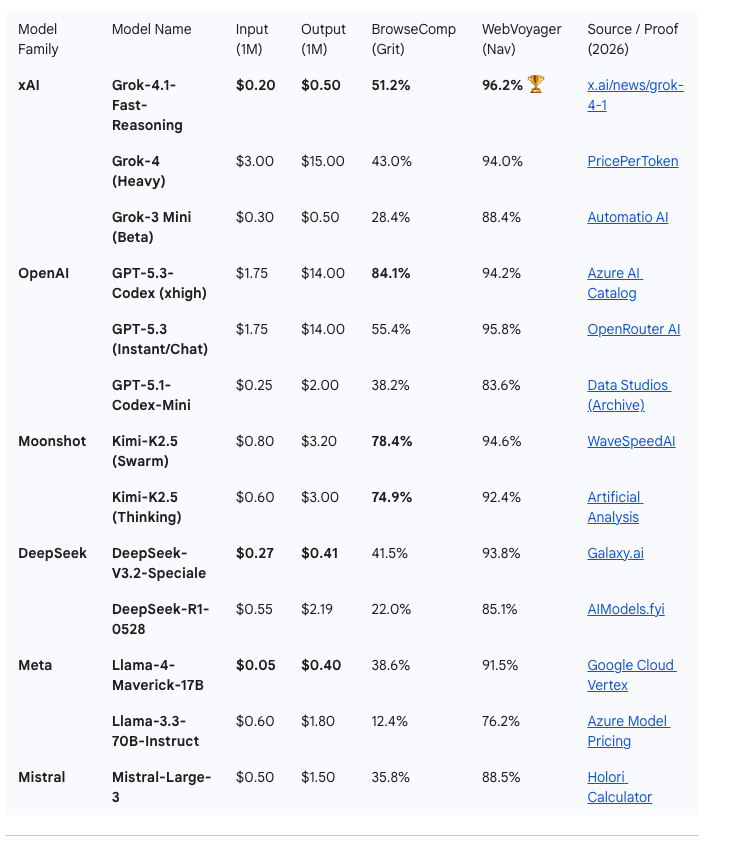
| Model / Agent | BrowseComp (Persistence) | WebVoyager (Nav Success) | OSWorld (Computer Use) | Reasoning Architecture |
|---|---|---|---|---|
| GPT-5.3-Codex | 88.2% | 94.2% | 64.7% | xHigh Recursive Loop |
| Gemini 3.1 Pro | 85.9% | 92.4% | 57.2% | Native Multi-Stage |
| Claude 4.6 Opus | 84.0% | 91.2% | 72.7% | Thinking Mode v2 |
| Kimi-k2.5 (Swarm) | 78.4% | 94.6% | 63.3% | 100-Agent Swarm |
| Qwen 3.5 (122B) | 76.5% | 93.5% | 62.2% | Early-Fusion Visual |
| MiniMax-M2.5 | 76.3% | 88.4% | 34.8% | Lightning MoE |
| Surfer 2 (H Company) | 62.8% | 97.1% | 60.1% | Visual Specialist |
| GPT-5.3 (Regular) | 52.1% | 95.8% | 58.4% | Standard / Instant |
Methodology Note: Scores reflect standardized, reproducible evaluations (multi-run averages where available) using official harnesses as of March 2026. Real-world performance can vary ±5-12% depending on site dynamics, anti-bot measures, and agent framework.
Analysis: The Great Split of 2026
The data reveals three distinct philosophies in agent design:
The Visual Specialists Surfer 2 (H Company, powered by Holo architecture) is the undisputed king of precise "see-and-click" navigation, achieving 97.1% on WebVoyager — a massive edge on visual-heavy sites. Its purely pixel-based grounding handles UI shifts effortlessly. However, it lacks deep logical persistence on 50+ step, multi-domain tasks (only 62.8% on BrowseComp).
The Recursive Thinkers GPT-5.3-Codex and Gemini 3.1 Pro dominate BrowseComp by treating failures like code bugs. They enter self-healing recursive loops to recover from 404s, CAPTCHAs, or layout changes — delivering superior long-horizon reliability. Claude 4.6 Opus balances this with the strongest general computer-use performance.
The Swarm Revolution Kimi-k2.5's native 100-agent swarm enables massive parallel exploration and information synthesis, producing a clear leap on complex research tasks. This architecture trades some sequential precision for breadth and speed.
Claude 4.6 Opus remains the most balanced all-rounder, especially for desktop-level computer use.
Engineering the Native Agent Environment: VibeBrowser.app
The smartest models in history are still forced to run inside browsers built for human eyes and fingers. VibeBrowser.app is the purpose-built "Native OS" that unlocks their full potential:
Token-Thinning Engine — Strips ~55% of irrelevant DOM noise, extending effective context windows for recursive thinkers (GPT-5.3-Codex, Claude, Gemini) on ultra-long tasks while slashing API costs.
Native Tool-Calling & Kernel Hooks — Bypasses JavaScript traps and provides stable element access for Qwen 3.5, MiniMax-M2.5, and Kimi Swarm agents.
Visual Stealth Layer — Optimized rendering, accessibility-tree feeds, and fingerprint masking dramatically reduce CAPTCHA and bot-detection hits that plague pure visual agents like Surfer 2.
The result: higher success rates, lower costs, and fewer human interventions — regardless of the underlying architecture.
Stop browsing. Start Vibe-ing. Experience the engine at VibeBrowser.app.
References & Proofs
- BrowseComp scores & methodology: OpenAI BrowseComp benchmark (arXiv:2504.12516) and independent evaluations (llm-stats.com, March 2026).
- WebVoyager & Surfer 2 (97.1%, 60.1% OSWorld): H Company technical report & arXiv:2510.19949; cross-verified on Steel.dev leaderboard.
- Kimi-k2.5 Swarm: Moonshot AI K2.5 Technical Report (Jan 2026) — documented parallel-agent gains and OSWorld results.
- Claude 4.6 Opus (OSWorld 72.7%) & GPT-5.3 series: Anthropic/OpenAI system cards (Feb 2026) and OSWorld leaderboard.
- Additional comparative data: MiniMax, Qwen, and Gemini reports plus Steel.dev WebVoyager rankings (March 2026).