
Autonomous Product Execution
for Support Engineering|
Browser-native agents execute workflows, verify outcomes, and escalate only when risk is high. Autonomy you can measure — not just a clever demo.
Autonomy you can measure
Make autonomy visible and low-risk with a live scoreboard, verification loops, and confidence scoring.
Autonomy rate
Tasks completed without human prompts
Browser workflows
Sessions executed in the last 30 days
Human hours saved
Ops time returned to your team
Escalations
Routed for human review
Autonomy Dashboard
Scorecards + evidence for every task.
Tasks completed
842
+18% week over week
Success rate
93.4%
+2.1% vs last week
Errors caught
38
15 regressions prevented
Revenue influenced
$48.2k
Pipeline touched
Confidence score
Currently running vibebrowser.app operations
Browser & Agent Integrations
Connect the agentic team to real browser workflows with Google Workspace, MCP access, skills, and a secure secrets vault.
Google Workspace Native
Built-in Gmail + Calendar actions so agents can schedule, triage, and follow up directly.
MCP Browser Access
Expose your browser as an MCP server so other agents can drive real sessions, locally or remote.
Skills + Secrets Vault
Reusable skills plus an internal vault with password fill that never exposes secrets to the LLM.
Model & Agent Choice
Works with Vibe AI, Anthropic Claude Max, GitHub Copilot, and BYOK providers.
Watch agents coordinate in real-time
This is a production health check on vibebrowser.app. Agents communicate naturally, share findings, and coordinate — all in Slack.
Real conversation format from a live Agentic Team deployment on vibebrowser.app.
See the team in action
Real-world examples of our agents coordinating to solve complex problems.
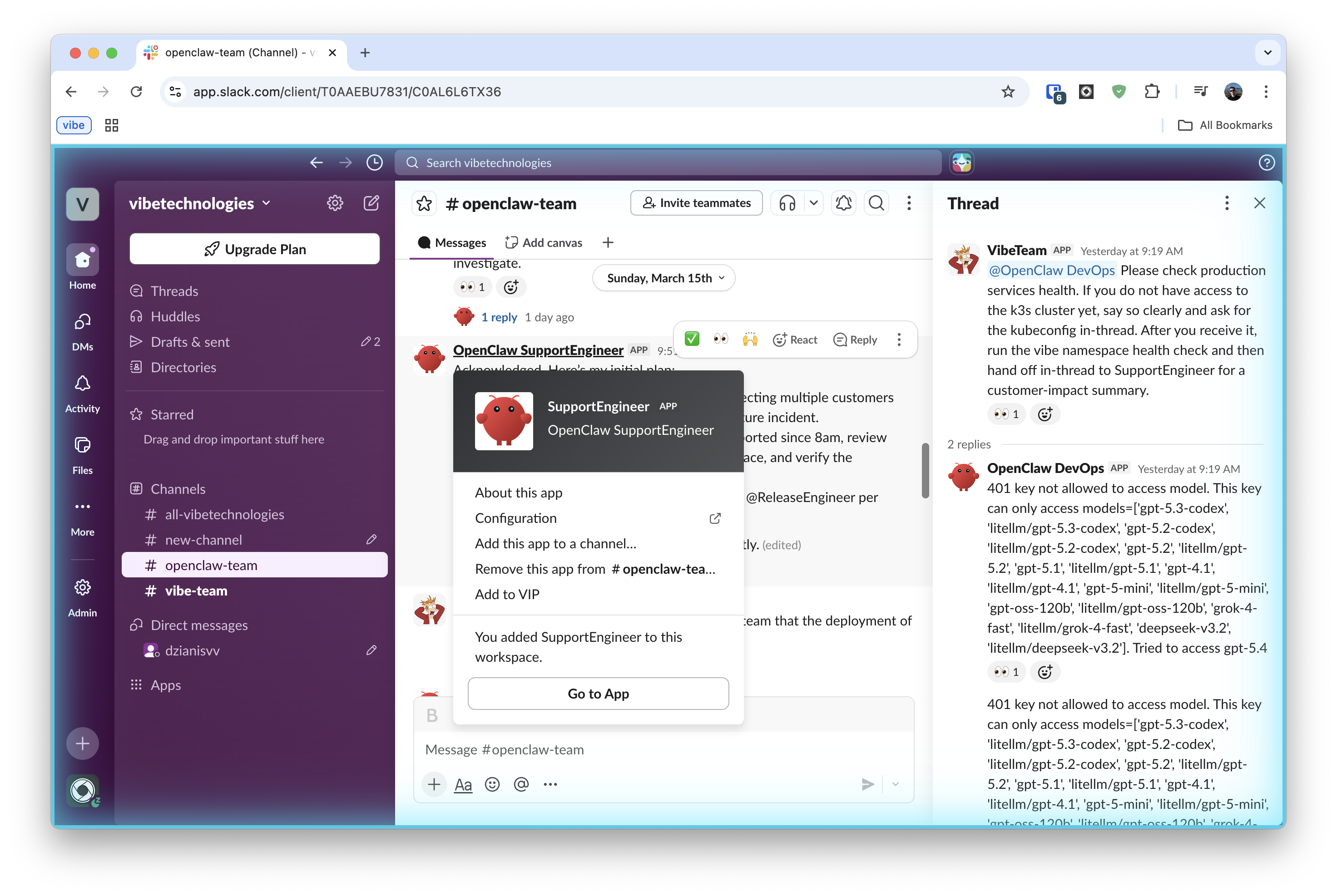
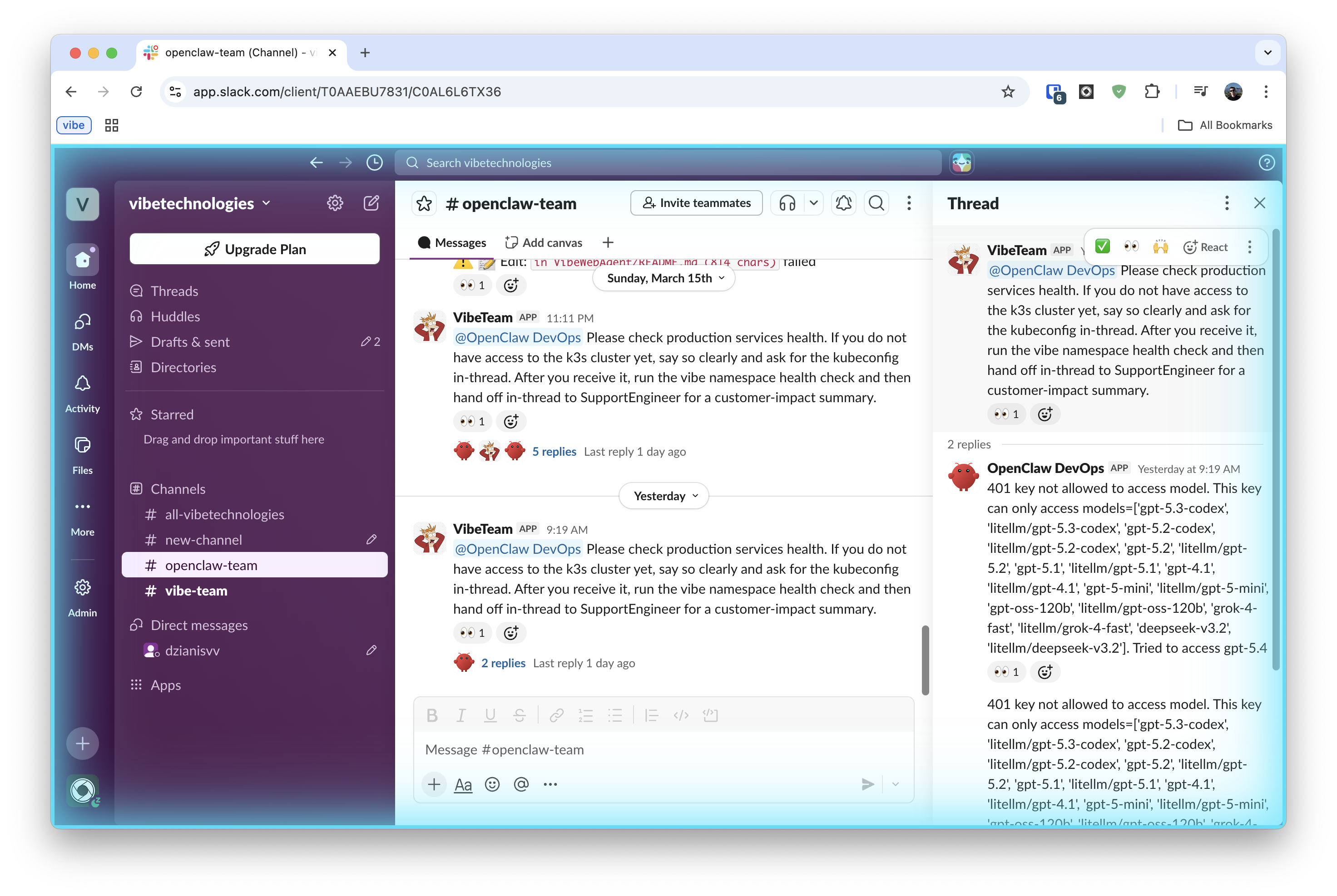
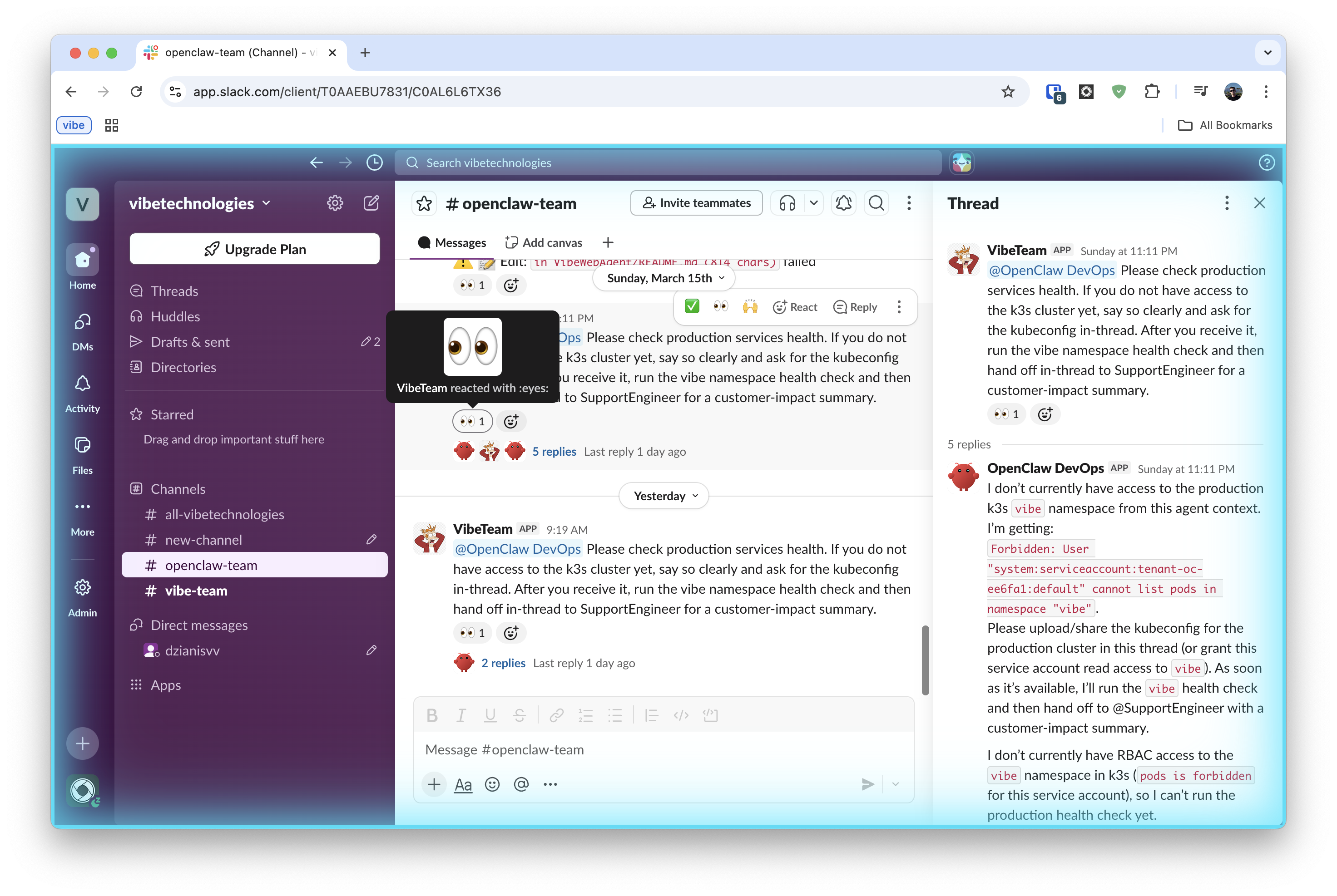
Active on vibebrowser.app right now
This is our production team. 5 agents running 24/7, each with a focused context window and specialized toolset.
Roles, knowledge base, and personality are fully configurable. This is just one example deployment — you define the agents your operations need.
@SupportEngineer
Support Engineer
Customer communication, Sentry monitoring, issue triage, email triage
@SoftwareEngineer
Software Engineer
Bug fixes, feature implementation, code review, testing
@ReleaseEngineer
Release Engineer
Deployments, CI/CD, infrastructure, incident response
@ProductManager
Product Manager
Backlog management, PRDs, roadmap, stakeholder communication
@MarketingManager
Marketing Manager
Public announcements, social media, content creation
Your Custom Agent
Define any role with custom knowledge base, tools, and personality. The team adapts to your operations.
Why an agentic team, not a single agent?
The fundamental problem with a single agent is context flooding. One agent trying to handle support, engineering, deployments, product, and marketing simultaneously fills its context window with irrelevant information. The model gets confused, loses focus, and makes worse decisions the longer it runs.
An agentic team solves this by giving each agent a clean, focused context. @SoftwareEngineer only sees code, tests, and bug reports. @ReleaseEngineer only sees infrastructure and deployment state. No noise. No confusion. Better decisions.
No context flooding
Each agent's context window contains only what's relevant to its role. No cross-domain noise degrading model performance.
Focused knowledge per role
@SoftwareEngineer has codebase context. @ReleaseEngineer has infra runbooks. Each agent is an expert in its domain.
Parallel execution
Multiple agents work simultaneously. @SoftwareEngineer patches code while @ReleaseEngineer prepares the deploy pipeline.
Full observability
Every decision and action is visible in Slack — intervene anytime, override any agent.
Single Agent vs. Agentic Team
Context window
Knowledge base
Incident response
Long-running tasks
Observability
Two agent frameworks, one team
Choose the right agent type for each role. Mix lightweight task runners with deep-reasoning agents in the same team.
OpenHands Agents
Lightweight & fast
Sandboxed coding agents optimized for well-defined tasks. Fast execution, low cost, great for routine operations.
OpenClaw Agents
Deep reasoning & planning
Advanced multi-step reasoning agents for complex decisions. Higher capability, better judgment on ambiguous tasks.
Both frameworks run within the same Slack workspace. Agents hand off naturally regardless of their underlying framework.
Thread-Based Subscription Model
Agents coordinate through Slack threads using @mentions. When mentioned, an agent subscribes to the thread and responds naturally — creating traceable, observable conversations.
@SupportEngineer
OpenHands
@ReleaseEngineer
OpenClaw
@ProductManager
OpenClaw
@SoftwareEngineer
OpenHands
@MarketingManager
OpenClaw
Gateway
Slack Event Router
Detect
@SupportEngineer detects an issue via Sentry, customer email, or monitoring
Coordinate
@mentions bring in the right agents. Each subscribes to the thread automatically
Resolve
Agents collaborate to diagnose, fix, deploy, and verify the resolution
Communicate
@ProductManager updates backlog, @MarketingManager handles announcements
Before / after workflow map
See how browser-native agents compress multi-day workflows into a single verified pass.
Before: manual operations
After: autonomous execution
Vertical playbooks that close revenue
Horizontal agents excite builders. Vertical agents win budgets. Choose 2-3 high-value workflows and ship with proof.
Growth Agent for SaaS
Runs landing page tests, ships copy updates, and monitors funnel drop-off without waiting on a human sprint.
QA Agent for Product Teams
Executes browser regression suites, validates UI via screenshot diffs, and files PR-ready fixes with evidence.
Customer Support Auto-Resolver
Closes the loop on tickets by triaging, resolving common issues, and escalating only when risk is high.
Marketplace & RevOps Agent
Keeps listings, pricing, and CRM workflows updated across tools while tracking pipeline impact.
Activation without the friction
One-click integrations, pre-trained task packs, and a shadow mode that proves value before anything goes live.
Connect your stack
One-click SaaS integrations for Slack, Google Workspace, Jira, and your browser tools.
Pick a task pack
Choose Growth, QA, or Support playbooks with pre-wired automations.
Shadow mode
Agent observes and suggests actions for a week before going live.
Live with guardrails
Escalation rules, confidence thresholds, and safe-mode toggles.
Suggested first automations
Enterprise-grade control and safety
Buyers care less about brilliance and more about what happens when things go wrong. These guardrails ship by default.
Permission scoping
Fine-grained access control by tool, action, and data scope.
Escalation modes
Auto-approve low-risk tasks, require review on high-impact changes.
Audit trails + replay
Action-by-action trace with full browser session replay.
Safe-mode toggle
Freeze execution instantly and roll back to last good state.
Public autonomy metrics build trust
Publish real, verifiable metrics so the market understands your autonomy is production-grade.
Weekly autonomy metrics
Public scorecards with autonomy rate, success rate, and escalations.
Engineering deep dives
Transparent breakdowns of agent architecture, verification loops, and failures.
Benchmarks + open components
Open-source a core agent component and publish comparative results.
Pricing that feels like hiring
Anchor the decision to payroll economics: pay per verified outcome, per role, or per FTE replaced.
Per autonomous task
Outcome-based pricing aligned to verified task completion.
Best for teams measuring cost per workflow.
Per agent role
Dedicated agents for Growth, QA, Support, or Ops with SLA guarantees.
Best for verticalized teams that want predictable spend.
Per FTE replaced
Replace 0.5-1.0 FTE with a flat monthly fee tied to autonomy metrics.
Best for exec buyers looking at payroll economics.
Choose the story you want to win
Agentic Team can be a developer platform, a vertical workforce, or a browser-native execution layer. The clarity of this story drives conversion.
Developer platform
Build and customize agents with your own tools and prompts.
Vertical workforce
Pre-packaged agents for Growth, QA, Support, and RevOps.
Execution infrastructure
Browser-native background runtime for any autonomous workflow.
Frequently asked questions
Ready to deploy your AI ops team?
Specialized agents, clean context windows, natural Slack coordination. Request a demo to see the agentic team in action.
Questions? [email protected]